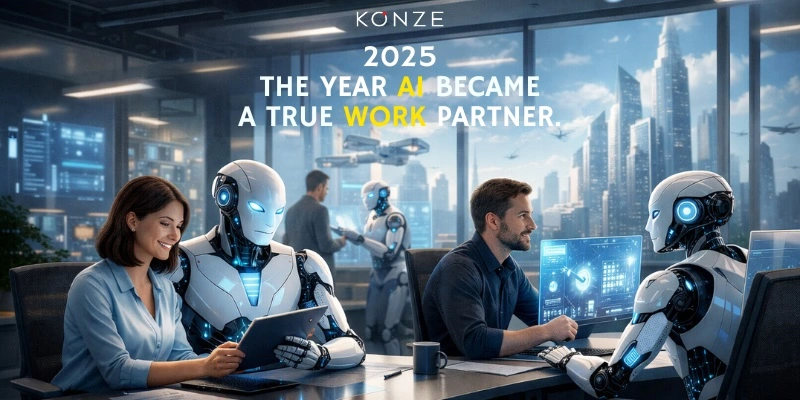
2025 wasn’t the year of AI hype.
It was the year of AI humility.
After years of bold promises, pilots and predictions, businesses finally confronted a more honest reality: artificial intelligence is powerful but only when used with intention.
At KONZE, we saw a clear shift across organizations worldwide. The conversation moved away from chasing "the next big AI breakthrough" and toward a far more grounded question:
How can AI make work simpler, smarter and more human?
The answers that emerged this year reveal where intelligent work is truly headed.
AI Finally Became a Team Player
In 2023 and 2024, many companies treated AI like a silver bullet an all-knowing system expected to replace effort overnight.
By 2025, the most successful organizations realized something better:
AI works best when it collaborates, not when it dominates.Teams that saw real results didn’t force people to adapt to AI. They trained AI around existing workflows. Instead of asking, "What can AI do?", they asked:
"What slows our people down and how can AI help remove that friction?"
That mindset turned AI from a buzzword into a teammate.
Efficiency Took a Back Seat to Experience
For years, AI adoption was driven by speed and cost savings. In 2025, that metric quietly changed.
Companies began measuring AI success not just by response times, but by how it felt to work with for both employees and customers.
AI that sounded robotic, lacked empathy, or forced rigid scripts quickly lost relevance.
What replaced it was a new standard:Empathetic Efficiency
Automation that accelerates outcomes without erasing the human touch.
This wasn’t about softer AI. It was about smarter design.
Subtraction Became the Boldest Innovation
The biggest obstacle to AI success in 2025 wasn’t fear or regulation.
It was complexity.Too many platforms.
Too many logins.
Too many disconnected systems.Organizations learned the hard way that layering AI on top of messy infrastructure doesn’t simplify work it magnifies dysfunction.
The companies that thrived made a counter intuitive move: they subtracted.
They removed redundant tools, clarified processes and embedded AI into clean, human centered foundations.
In 2025, simplification wasn’t a side task it was the strategy.
Subtraction became the real innovation.
Human Judgment Found Its Second Wind
2025 also proved something important: AI doesn’t replace human expertise it sharpens it.
The most effective teams used AI to handle the repetitive, routine and reactive. Humans focused on insight, empathy and creativity.
For example, AI could draft a first-pass report or summarize customer interactions while people provided strategic direction, nuance and decision-making.
Across customer service, HR, education and finance, AI became the co-pilot, not the captain.
That balance defined the strongest organizations of the year.
The AI Leaders of 2026 Will Be the Simplifiers
The lesson from 2025 is clear:
Complexity doesn’t scale. Clarity does.
As we move into 2026, the companies that stand out won’t be the ones deploying more AI but the ones deploying it wisely.
They’ll use intelligent systems to streamline, personalize and empower not overwhelm.
So, here’s the question that matters most going forward:
What is one complex process you’re ready to simplify next year?
Final Thought: AI’s Real Gift Was Time
AI’s greatest contribution in 2025 wasn’t automation or analytics.
It was time.
Time for people to think deeper.
Time to connect better.
Time to build work that actually matters.
And that’s something no algorithm can ever replace.
FAQs
Q1: What does it mean that 2025 was the "year of AI humility"?
2025 marked a shift from AI hype to practical reality. Instead of chasing grand promises or full automation, organizations learned that AI delivers real value only when applied with intention, clarity and respect for human workflows. The focus moved from "what AI can do" to "how AI can meaningfully support people."
Q2: How did successful companies actually use AI in 2025?
The most successful organizations treated AI as a collaborator, not a replacement. They embedded AI into existing workflows to remove friction, handle repetitive tasks and surface insights while keeping humans responsible for judgment, creativity and empathy.
Q3: Why did experience matter more than efficiency in AI adoption?
In 2025, companies realized that speed and cost savings alone weren’t enough. AI systems that felt rigid, robotic, or impersonal failed to gain adoption. Success came from "empathetic efficiency" automation that improves outcomes while preserving a human, intuitive experience for employees and customers.
Q4: What role did simplification play in AI success?
Simplification became the boldest form of innovation. Organizations discovered that adding AI to complex, fragmented systems only amplified inefficiencies. The strongest results came from reducing tools, clarifying processes and building clean foundations where AI could enhance work instead of complicating it.
Q5: What should organizations focus on as they move into 2026?
The AI leaders of 2026 will be simplifiers. Rather than deploying more AI, they’ll deploy it wisely using intelligent systems to streamline processes, empower people and give teams back time. The key question isn’t "Where can we add AI?" but "What complexity are we ready to remove?"