The Challenge
English proficiency test preparation often takes place across disconnected learning materials, coaching sessions, practice exercises, mock tests and trainer feedback.
While each activity contributes to preparation, learners can struggle to understand how their results relate to overall progress or what they should work on next. For education providers, delivering timely, personalised feedback can also become increasingly difficult as learner volumes grow.
The challenge was to create a single AI-powered test preparation platform that could connect these activities while supporting the different requirements of multiple PTE and IELTS examinations.
Supporting Multiple Examination Pathways
PTE Academic, PTE Core, PTE General, IELTS Academic and IELTS General have different examination structures, preparation requirements and question formats.
The learning architecture therefore needed to accommodate multiple examination pathways within one product while ensuring that curriculum, practice activities and assessments remained relevant to the test selected by each learner.
This required a flexible product structure rather than simply placing different sets of learning content inside the same interface.
Delivering Feedback at Scale
Another key requirement was learner feedback.
Traditional English test preparation often relies on trainers reviewing responses and explaining areas for improvement. Human guidance remains valuable, but relying on manual assessment for routine practice can create delays and make personalised support harder to scale.
The platform therefore required an AI-powered assessment layer capable of analysing learner responses and providing useful performance feedback during independent practice.
The objective was not simply to automate assessment, but to turn performance data into practical guidance that could inform what a learner should focus on next.
Keeping a Sophisticated Product Easy to Use
Combining AI tutoring, assessment, multiple examinations, mock testing and analytics introduced significant product complexity.
KONZE needed to ensure that this complexity remained behind the interface.
For learners, the experience had to stay clear: select an examination, follow the relevant preparation pathway, practise, receive feedback, complete mock tests and understand progress without navigating an overly complicated system.
The product also needed to reproduce key elements of real examination conditions, including structured sections and timed mock tests, while keeping results connected to the learner’s wider preparation activity.
The Solution
KONZE developed an end-to-end EdTech platform in which learning content, AI-powered assessment, personalised tutoring, mock examinations and learner performance data work together rather than as separate tools.
The product architecture was designed around how students actually prepare: learn, practise, receive feedback, identify weaknesses, test performance and repeat.
AI Tutor for Personalised Learning
KONZE developed an AI Tutor to provide learners with on-demand support throughout their preparation.
The tutor uses learner responses and performance information to provide contextual feedback and help students identify areas requiring additional practice. Instead of completing activities and receiving only a score, learners gain clearer direction on where to focus.
This enables personalised learning support to remain available beyond scheduled trainer interactions and creates a stronger connection between assessment and subsequent practice.
By incorporating the AI Tutor directly into the learning workflow, KONZE made AI part of the preparation experience rather than adding it as a standalone chatbot or supplementary feature.
AI-Powered Assessment and Performance Feedback
KONZE integrated AI-powered assessment into the platform to provide learners with faster visibility into their performance.
For PTE preparation, the assessment framework supports the core language areas of speaking, writing, reading and listening. Learner responses can be analysed during practice so that performance feedback becomes available within the preparation workflow.
Assessment data is also connected with broader learner activity, helping students recognise stronger areas, identify recurring weaknesses and make more informed decisions about where additional practice is required.
For education providers, this approach reduces dependence on manual evaluation for routine practice while allowing personalised feedback to be delivered across a larger learner base.
Multi-Exam Learning Architecture
KONZE engineered a flexible learning architecture capable of supporting PTE Academic, PTE Core, PTE General, IELTS Academic and IELTS General within the same platform.
Each examination can retain its relevant curriculum, activities and preparation pathway while sharing a common product environment.
Students can therefore move through content designed for their selected examination without switching between separate platforms or disconnected systems.
From a product perspective, this architecture also provides education businesses with a stronger base for managing and expanding multiple English test preparation offerings through one technology platform.
Realistic Mock Testing
KONZE developed full-length mock tests with structured sections, timers and exam-style workflows to help learners prepare for the practical demands of test day.
Rather than treating mock examinations as isolated exercises, results are connected with the platform’s wider performance tracking.
Learners can use mock-test outcomes alongside their practice history and assessment feedback to identify areas that need further attention before attempting another test.
This creates a more purposeful preparation cycle in which testing informs practice rather than simply producing another score.
Performance Tracking and Learning Experience Design
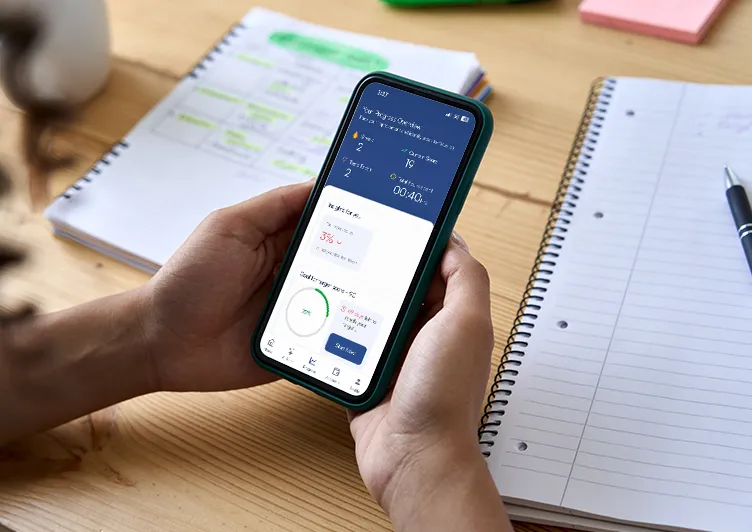
Performance visibility was built into the platform so learners could understand how their preparation was progressing across activities and assessments.
KONZE combined this data layer with UI/UX design focused on keeping navigation and learning workflows straightforward despite the sophistication of the underlying system.
The result is a learner experience that brings examination-specific content, AI support, assessments, mock testing and progress information together without exposing unnecessary technical complexity.
Business Value
The completed platform provides education businesses with a scalable model for delivering AI-powered PTE and IELTS preparation through a single digital product.
Learners can access structured curriculum, practise independently, receive AI-assisted feedback, complete realistic mock examinations and review their performance without moving between multiple systems.
For education providers, AI-powered assessment can reduce the amount of routine evaluation that depends entirely on manual trainer input. This makes it possible to extend personalised learning support to more students while allowing trainers to focus their attention where human guidance adds the greatest value.
The multi-exam architecture also allows different PTE and IELTS preparation pathways to operate within a common technology environment, creating a more efficient foundation for managing and expanding digital learning products.
From a product-development perspective, the project demonstrates KONZE’s ability to bring together AI/ML development, product engineering, UX, learner data and cloud infrastructure to build production-ready EdTech solutions.
Rather than using AI as an isolated feature, KONZE integrated it into the core learning workflow—connecting learner responses, assessment, feedback, practice and performance tracking within one platform.
For education companies looking to build AI-powered learning products, the project demonstrates how KONZE can turn complex learning and assessment requirements into scalable digital products designed around real user journeys.
Building an AI-powered EdTech product? Talk to KONZE.